Payment gateway
 Payment Link

 Buy now pay later
 Scan to pay QR

 SmartPOS
 Collection support
 Pay-out support
 Appota E-wallet

 Top up service
 Charging service
 Press
 Promotions
 Events
 Blog


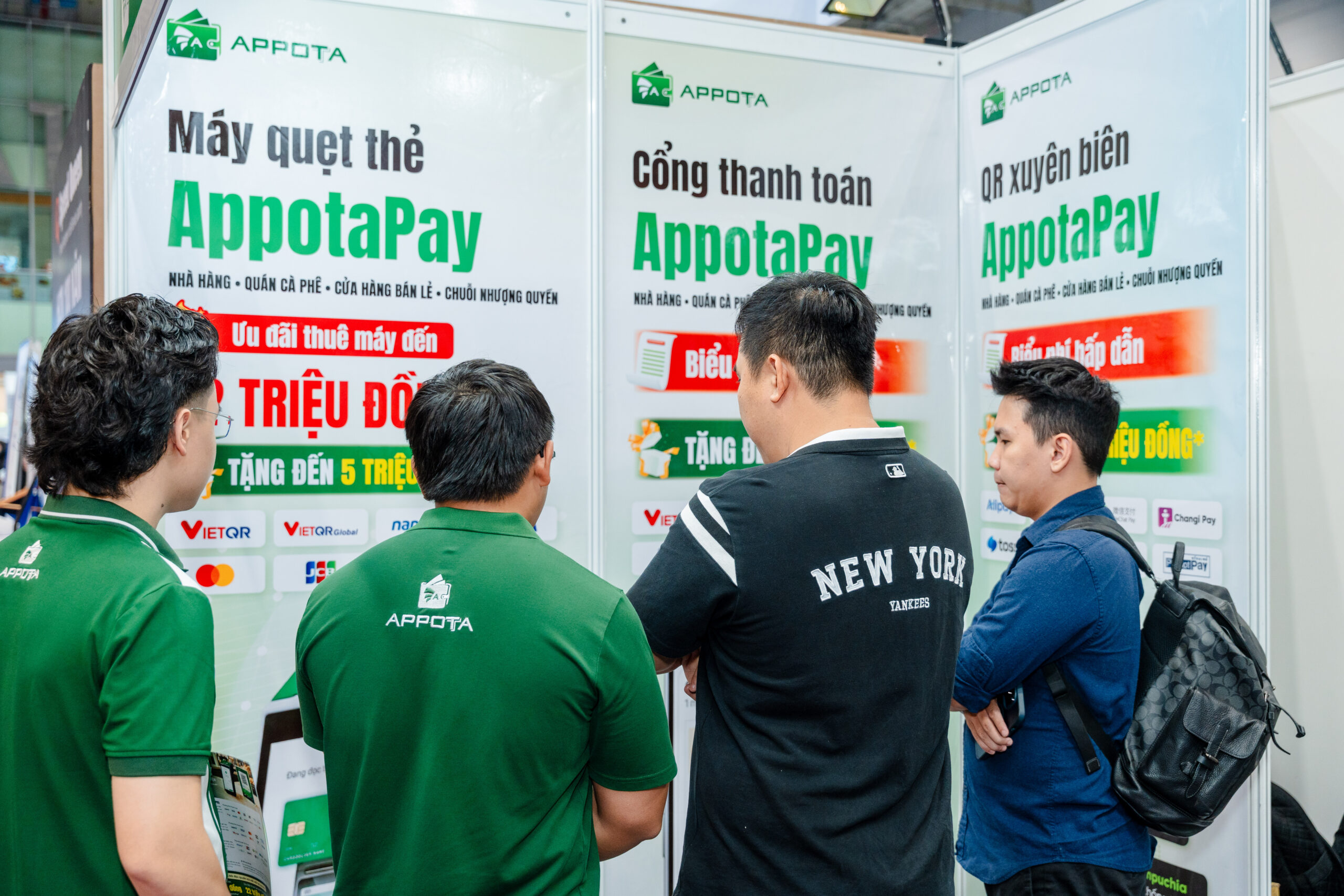
At the Vietnam International Franchise Show 2026 (VIFS 2026), AppotaPay introduced payment solutions tailored to retail businesses, F&B operators, and franchise chains.
The Vietnam International Franchise Show 2026 (VIFS 2026), held from October 29–31 at the Saigon Exhibition and Convention Center (SECC) in Ho Chi Minh City, brought together businesses from the retail, F&B, and franchising sectors. At the event, AppotaPay introduced payment solutions tailored to retail businesses, F&B operators, and franchise chains amid changing consumer spending patterns and shopping behaviors that are reshaping how businesses manage and process transactions. AppotaPay also presented two in-depth reports on retail and F&B spending trends, connecting the evolving consumer landscape with businesses’ payment and operational requirements.

Diverging consumer spending patterns add complexity to business operations
According to AppotaPay’s report, Decoding Vietnam’s Retail Spending Trends 2026, although purchasing activity has shown signs of recovery ahead of the year-end peak season, consumers remain cautious about their spending decisions.
The report found that 89.5% of respondents tend to compare prices across retailers, while 39.5% are willing to postpone purchases in anticipation of promotional offers. Price and perceived value therefore continue to play a significant role in purchasing decisions. However, more cautious spending does not mean lower expectations for the shopping experience. The survey cited in the report found that 49% of convenience store shoppers consider checkout and payment speed “very important” when choosing where to shop.
Consumers are therefore becoming more selective about how they spend while maintaining high expectations for convenience and speed. For retail and F&B businesses, the challenge extends beyond attracting consumer spending to meeting customer expectations and efficiently managing the resulting transactions.
As businesses expand across multiple outlets and sales channels, the volume of transactions requiring monitoring, reconciliation, and management also increases, making operations increasingly complex for chain businesses.
Payment infrastructure faces growing omnichannel demands
At VIFS 2026, AppotaPay had the opportunity to introduce and provide consultation on payment solutions for retail businesses, F&B operators, and franchise chains. Discussions focused on the requirements that emerge as businesses scale, ranging from connecting transactions across physical stores and online channels to managing collections and disbursements across their operations.
According to AppotaPay, its experience in implementing services for more than 600 businesses shows that payment requirements vary across business models. For retail, the priority is monitoring transactions across physical stores and online channels. In F&B, fast transaction processing during peak hours must go hand in hand with the ability to track transactions by shift, employee, and location. For franchise chains, requirements extend to managing collections and disbursements across multiple business entities, agents, suppliers, and partners.
A common challenge across these models is that as businesses expand across multiple channels, the number of transactions requiring monitoring and reconciliation grows accordingly. When channels operate in silos, manual processing workloads increase, particularly for businesses managing multiple outlets.
In response, AppotaPay has developed solutions tailored to different payment channels. At physical points of sale, SmartPOS and SoftPOS support multiple payment methods while enabling transaction tracking by shift and outlet. For online channels, the Payment Gateway and Payment Link facilitate transactions through websites, applications, and payment links.
For international customers, cross-border QR payment solutions allow businesses to accept payments through supported applications in travelers’ home markets, with settlements received in Vietnamese dong (VND). Virtual accounts and disbursement support solutions help businesses identify incoming payments, reconcile transactions, and make payments to agents, suppliers, and partners.
For chain businesses, the requirement therefore goes beyond expanding payment methods. Equally important is the ability to centrally manage transactions across multiple outlets and sales channels. This enables businesses to reduce manual reconciliation workloads while improving revenue visibility and cash flow control.
“Through VIFS 2026, AppotaPay aims not only to introduce payment solutions but also to provide market insights that help businesses better understand changes in consumer spending patterns and purchasing behavior. In the long term, we aim to build flexible payment infrastructure that enables retail businesses, F&B operators, and franchise chains to expand across multiple outlets and channels while maintaining effective control over transactions and cash flow,” said Dao Tuan Anh, Chief Executive Officer of AppotaPay.