Payment gateway
 Payment Link

 Buy now pay later
 Scan to pay QR

 SmartPOS
 Collection support
 Pay-out support
 Appota E-wallet

 Top up service
 Charging service
 Press
 Promotions
 Events
 Blog


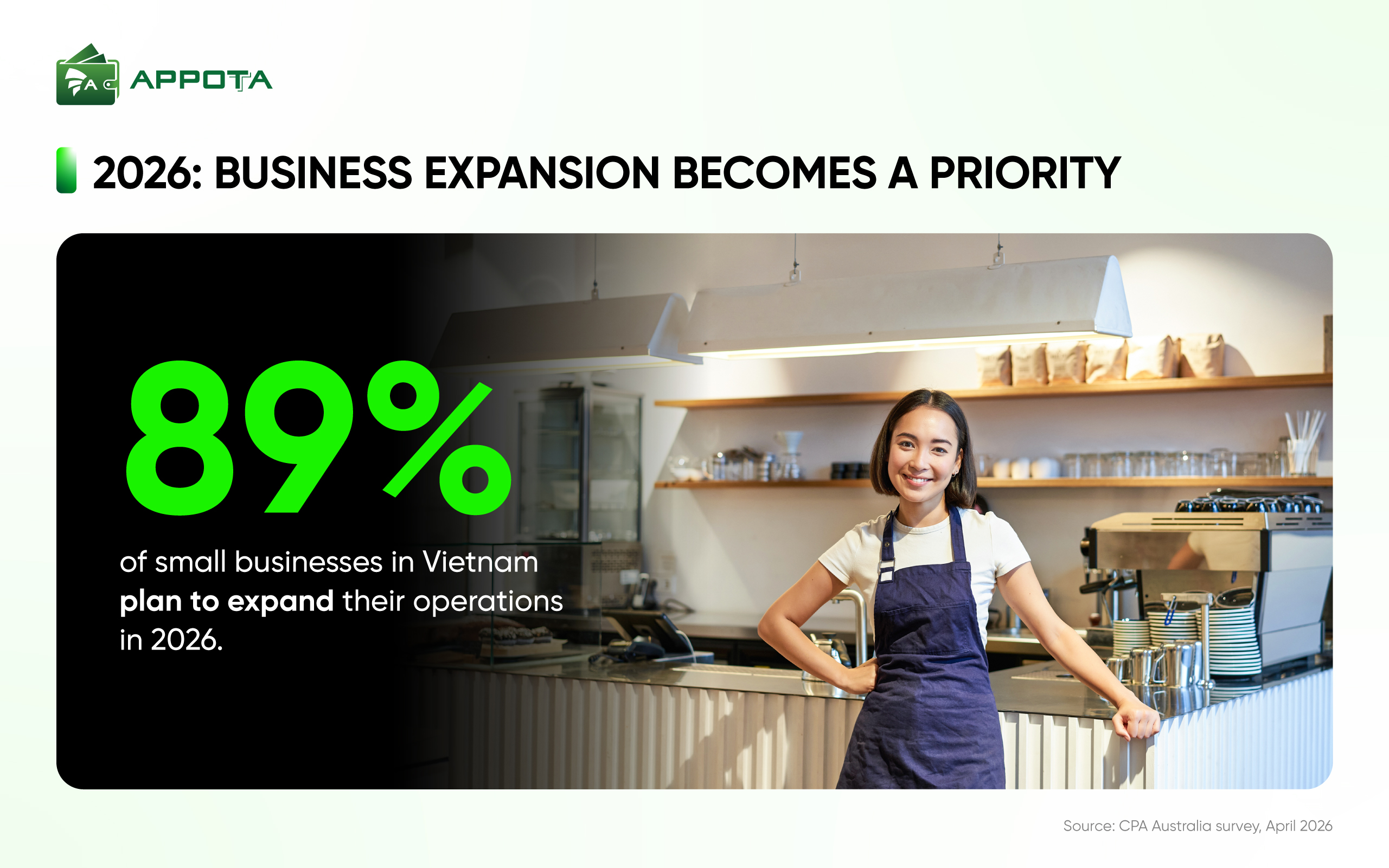
According to a survey published by CPA Australia in April 2026, 89% of small businesses in Vietnam plan to expand their operations in 2026. However, replicating a successful business model requires careful preparation, from financial performance and operational processes to management systems and payment infrastructure.
Here are five key steps businesses should take to maintain control over performance as they scale.
Assess whether your business model is scalable
Before opening additional stores, businesses need to determine whether their current model can perform effectively in other locations. A store with high foot traffic does not necessarily generate strong profits if rent, staffing, and ingredient costs are too high.
What should businesses do?
- Evaluate business performance: Track revenue, profit margins, operating costs, break-even points, and payback periods.
- Research target markets: Analyze customer segments, purchasing power, competitors, and rental costs in potential expansion areas.
- Set criteria for new locations: Establish minimum revenue targets, investment budgets, and performance benchmarks for new outlets.
Practical example: A coffee shop owner is planning to open another branch. Before making a decision, the owner needs to assess whether projected revenue will cover rent, staffing, and ingredient costs. They should also research the local market and customer base at the new location. If the first store attracts customers mainly because it is near office buildings, the owner should validate whether the model can succeed in a residential area, where customer needs and consumption habits may differ.
Standardize operating procedures
When a business operates only one store, the owner can directly oversee beverage quality and customer service. However, as more branches open, relying on individual managers’ experience can lead to inconsistencies in product quality and customer experience.
What should businesses do?
- Develop standard operating procedures (SOPs): Clearly define how each task should be performed, from serving customers to handling complaints.
- Standardize products and services: Maintain consistent ingredient quantities, recipes, preparation times, and service standards.
- Establish training and quality-control processes: Develop training materials and evaluation criteria for staff across all outlets.
Practical example: A latte should follow the same recipe, ingredient measurements, and presentation standards across every store. The brand owner can create a barista handbook, training videos, and quality-control checklists to ensure that new employees at the second branch can consistently prepare drinks to the required standard.
Invest in payment infrastructure that supports chain operations
Payment is not merely the final step in the purchasing journey. It also affects service speed, customer experience, and the ability to monitor revenue. If each store uses different payment methods or reconciliation procedures, managing the entire business becomes more complicated as the chain grows.
What should businesses do?
- Support a wide range of payment methods: Accept domestic bank cards, domestic and international bank or e-wallet QR payments, and installment payments for businesses selling high-value products.
- Standardize transaction processes: Establish consistent procedures for payment processing, refunds, and reconciliation across all outlets.
- Improve financial oversight: Prioritize solutions that enable revenue tracking, branch-level access controls, and faster reconciliation to support more effective cash flow management.
- Plan for scalability: Choose infrastructure that allows new outlets to be added without rebuilding the entire payment process.
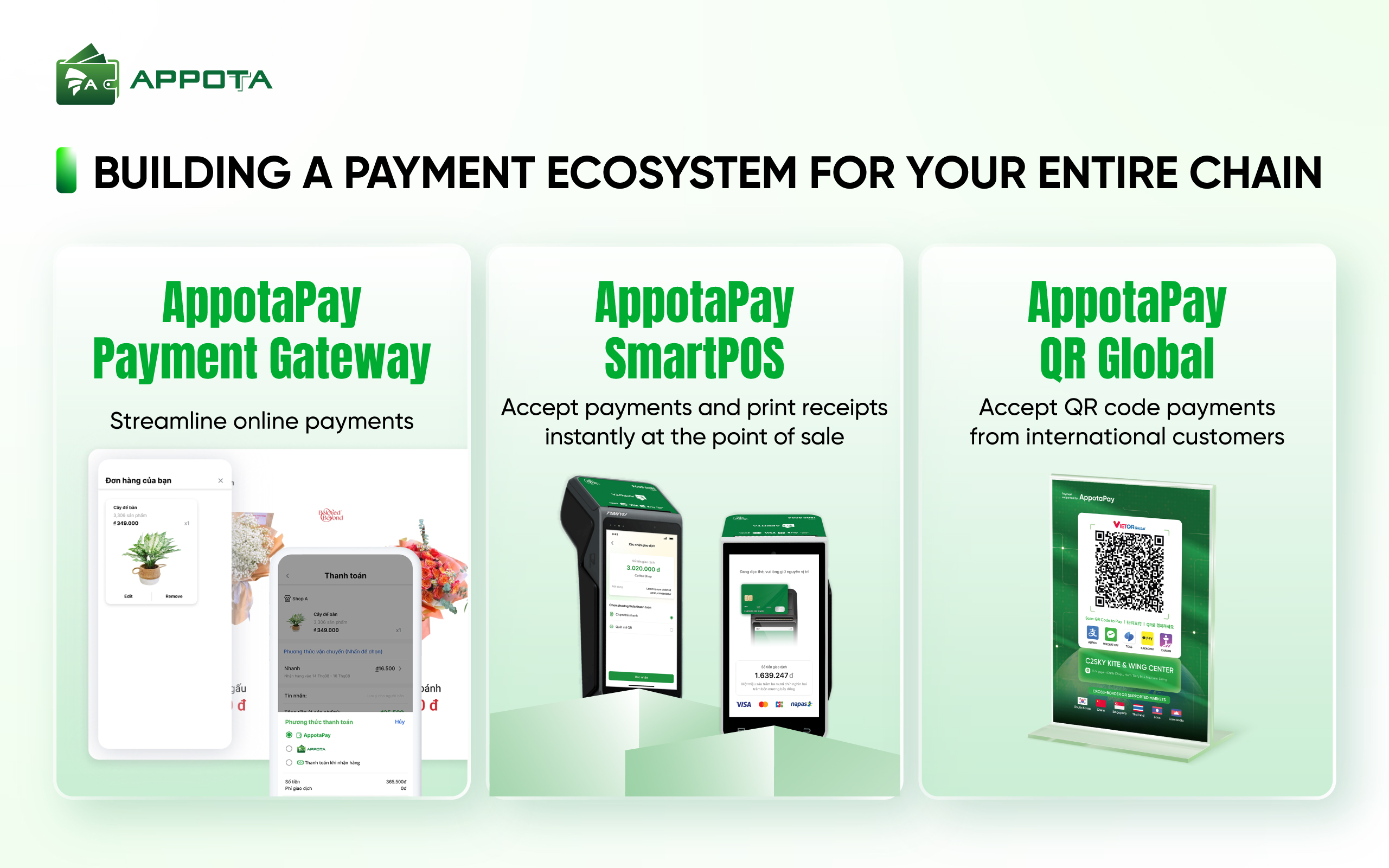
Practical example: With AppotaPay’s comprehensive payment solutions, a coffee shop can serve customers across both online and offline channels while maintaining consistency across multiple branches. AppotaPay SmartPOS supports in-store payments at the counter, while the AppotaPay Payment Gateway processes transactions for orders placed through mobile apps. AppotaPay QR Global enables the shop to serve international customers more conveniently through cross-border QR payments.
Build a centralized management and data system
As the number of outlets increases, monitoring business performance becomes more difficult when each store maintains separate records. Without timely access to information, managers may be slow to identify unusual costs or determine which branches are underperforming.
What should businesses do?
- Define the key performance indicators to monitor: These may include revenue, order volume, average order value, operating costs, and inventory levels.
- Choose suitable management tools: Consider point-of-sale software, accounting systems, and platforms that can integrate data.
- Establish reporting and access-control procedures: Define access rights based on job responsibilities and standardize how data is consolidated across branches.
Practical example: A coffee shop owner needs to know which store performs best in the morning, which drinks generate the most sales, and which branches frequently have excess inventory. Rather than waiting for individual managers to submit end-of-day reports, a centralized management system can consolidate data, allowing the owner to compare performance and adjust purchasing plans accordingly.
Test and measure before scaling further
Even when a business model is performing well and its processes are standardized, rolling out multiple new locations at once can increase risk if the model has not been validated in different markets. A phased approach helps identify problems and refine operations before the next stage of expansion.
What should businesses do?
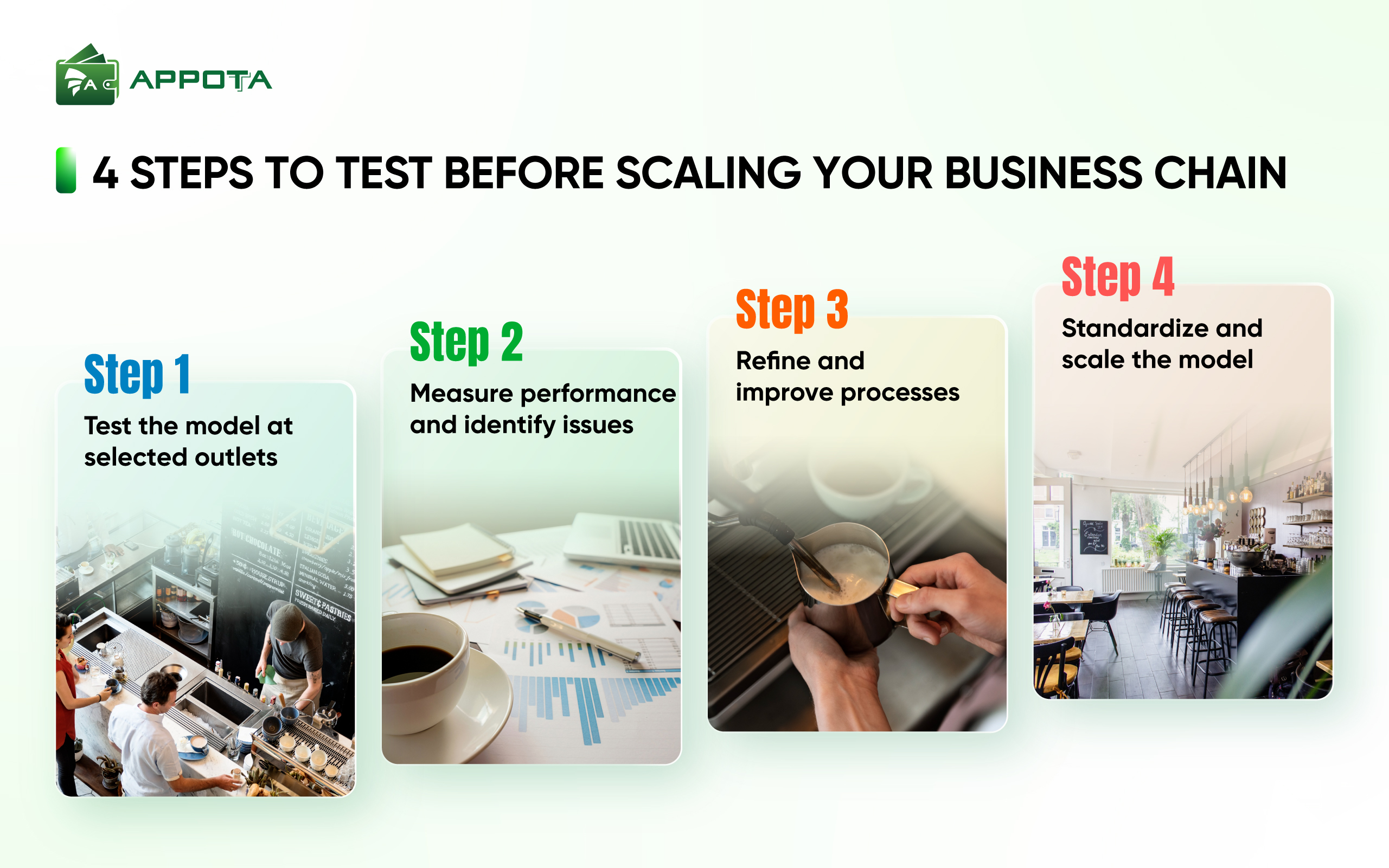
- Pilot the model at selected outlets: Test it in new locations or markets.
- Measure performance and identify issues: Compare revenue, costs, service quality, and operational efficiency against initial targets.
- Refine operating procedures: Address issues related to staffing, supply chains, technology, or customer experience.
- Standardize and scale: Finalize procedures, performance criteria, and implementation plans for subsequent outlets.
Practical example: After opening a second branch, a coffee shop owner can track hourly revenue, repeat-customer rates, service times, and ingredient costs over the first few months. If revenue falls short of expectations because the customer base differs from that of the original store, the owner can adjust the product lineup or staffing plan before opening a third location.
Successful expansion requires strong operational capabilities
From validating a business model and standardizing processes to integrating data and investing in payment infrastructure, each step helps build the foundation for sustainable expansion. The goal is not simply to open more stores, but to build a business that can grow while maintaining consistent quality and effective operational control.
Through SmartPOS, QR Global, and Payment Gateway, AppotaPay aim to help businesses identify suitable solutions to optimize payment operations, improve operational efficiency, and prepare for their next stage of growth.
Connect with AppotaPay today:
- Hotline: 1900 6004
- Email: [email protected]