

 Payment gateway
 Payment Link

 Buy now pay later
 Scan to pay QR

 SmartPOS
 Collection support
 Pay-out support
 Appota E-wallet

 Top up service
 Charging service
 Press
 Promotions
 Events
 Blog


QR payments are growing rapidly in Vietnam while expanding their reach across international markets. This shift is reshaping consumer payment habits and raising new expectations for businesses’ payment acceptance capabilities, particularly in F&B, tourism, hospitality, and retail.
QR payments: From an emerging trend to a mainstream payment method
QR payments are becoming increasingly common across retail stores, restaurants, coffee shops, and shopping malls. According to data shared by NAPAS at its 2026 Customer Conference, Vietnam recorded 4.44 billion QR payment transactions in the first nine months of 2026, up 41.3% year over year. Total transaction value reached VND 8.96 quadrillion, representing a 12.2% increase compared to the same period in 2025.
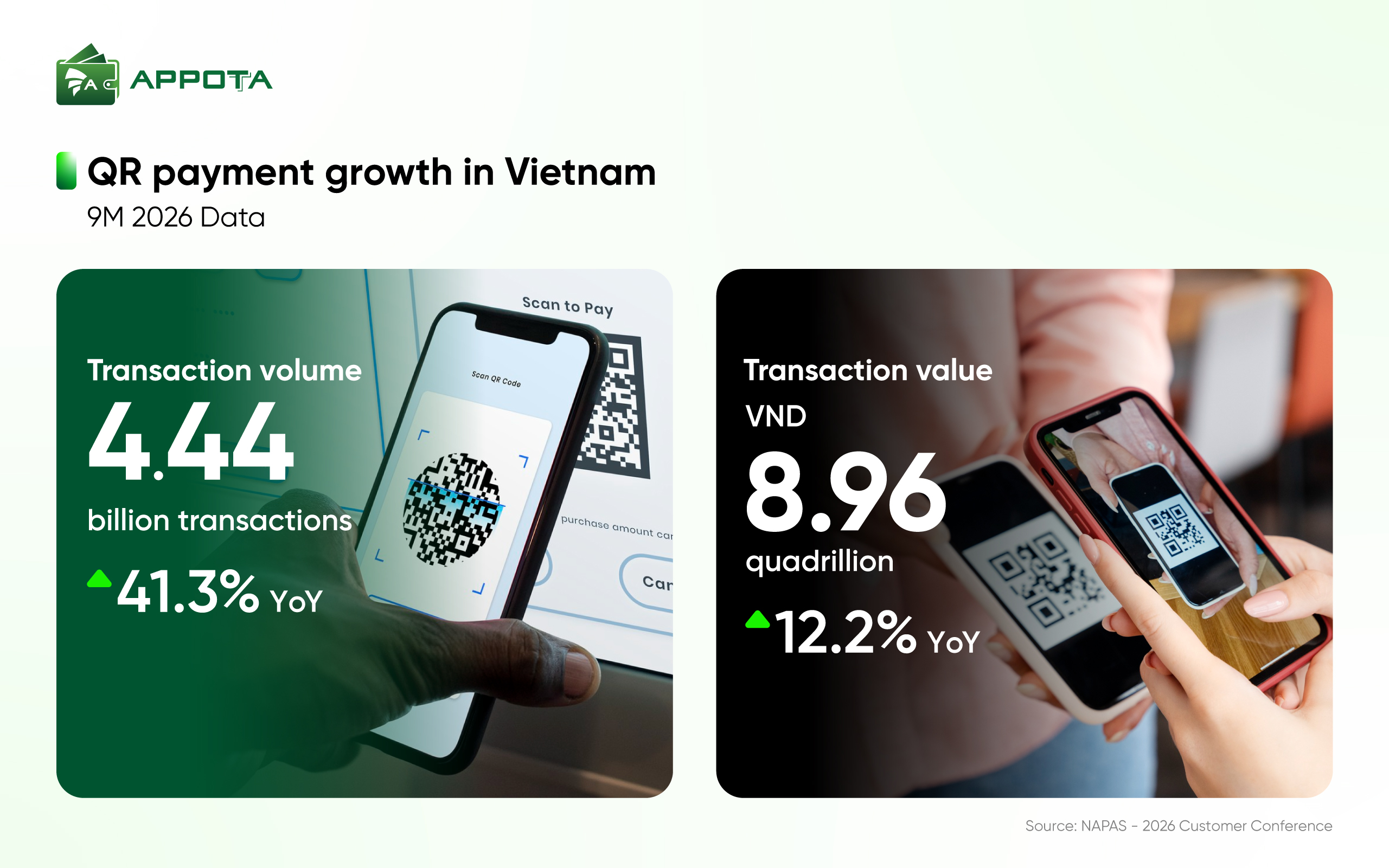
Notably, transaction volume grew significantly faster than transaction value. This indicates that QR payments are becoming a regular part of everyday spending, rather than being used primarily for high-value purchases.
For businesses, QR payment acceptance offers benefits across both customer experience and operational efficiency:
- Multiple funding sources: Accept payments from bank accounts, e-wallets, and other supported payment sources.
- Instant transaction notifications: Receive timely payment status updates and reduce manual verification.
- Operational efficiency: Reduce reliance on cash while simplifying checkout and reconciliation processes.
- System integration: Connect with sales management software to synchronize transactions and improve revenue tracking.
As QR payments become part of everyday consumer behavior, accepting them is no longer just an added advantage. It is increasingly becoming a basic requirement at the point of sale.
Cross-border QR payments: Expanding access to international customers
Beyond domestic transactions, QR payments are extending into cross-border commerce, allowing consumers to use familiar payment apps when shopping in other countries.
In the first eight months of 2026, QR code payment transactions reached 311 million, with a total transaction value of VND 274.2 trillion. This represented year-over-year growth of 6.66% in transaction volume and 25.85% in transaction value.
The international QR payment network connected through NAPAS currently spans six markets: Thailand, Laos, Cambodia, China, South Korea, and Singapore. In 2027, the network is expected to expand further into India, the Philippines, Malaysia, Taiwan, Japan, and Indonesia.
Cross-border QR payment network at a glance
- 200,000+ merchant locations across F&B, tourism, and retail.
- ~50,000 inbound transactions per month – international visitors making payments in Vietnam.
- ~100,000 outbound transactions per month – Vietnamese consumers making payments overseas.
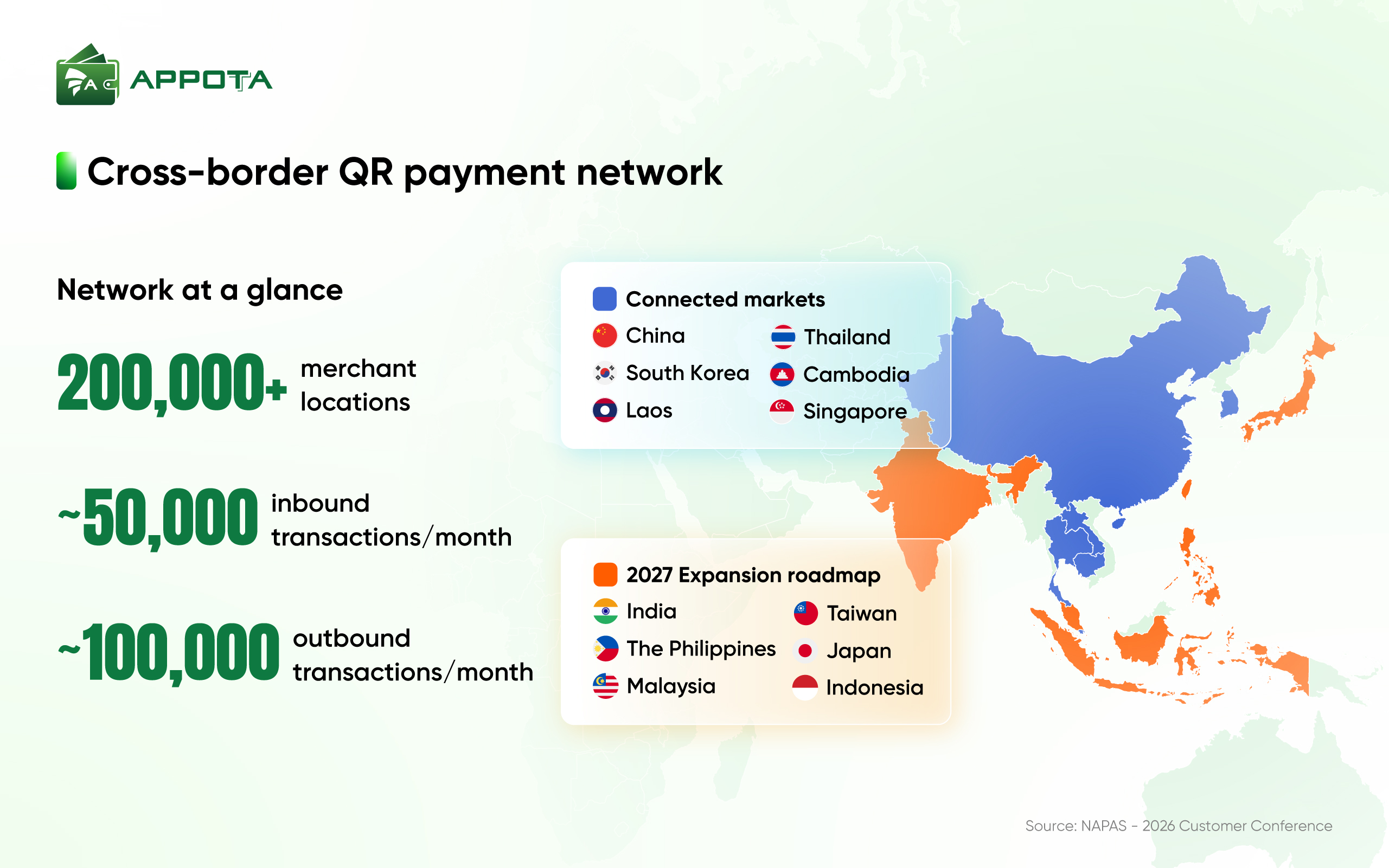
This expansion creates new opportunities for Vietnamese businesses to serve international customers. Rather than having to implement multiple payment methods for different markets, businesses can accept payments through compatible banking apps and e-wallets that international visitors already use in their home countries.
For businesses in tourism, hospitality, F&B, and retail, cross-border QR payments can reduce payment barriers at the destination and help capture more spending from international visitors.
Payment acceptance capabilities: A business priority to address
The payment landscape is evolving faster than some businesses can adapt. As consumers become accustomed to domestic QR payments and gain access to more cross-border payment options, the lack of suitable payment methods can become a barrier to completing transactions – and ultimately result in lost revenue.
For businesses serving international customers, attracting visitors is only part of the equation. They must also make it easy for those customers to complete their purchases. A restaurant, hotel, or retail store may offer products and services that meet customer expectations, but still face a disadvantage if customers cannot pay using their preferred methods. Without cross-border QR payment acceptance, businesses risk leaving a significant share of international customer spending untapped.
To address this demand, QR Global – AppotaPay’s cross-border QR payment solution – offers two implementation options for businesses:
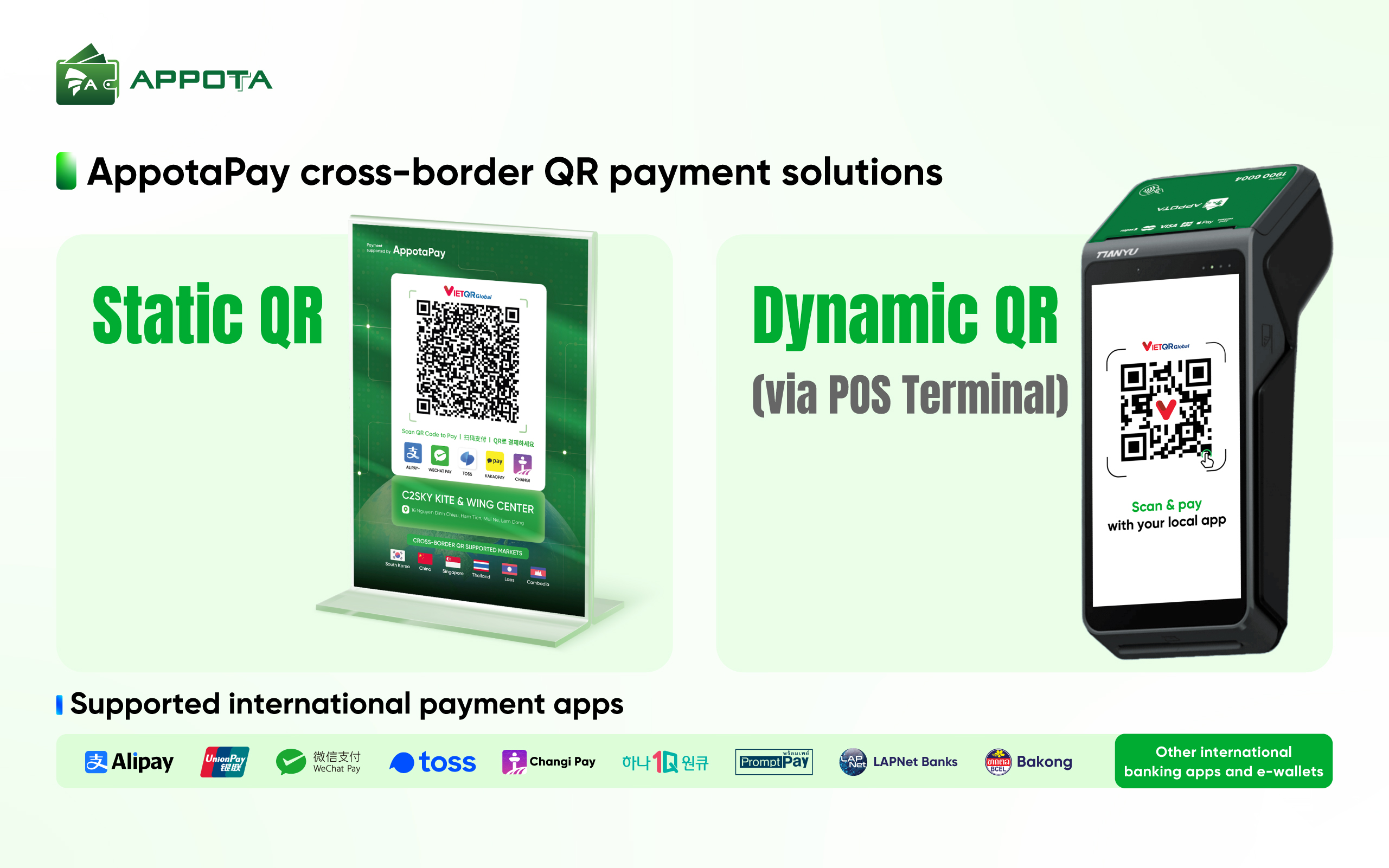
- Static QR Global: A QR code standee can be placed at checkout counters or service areas, allowing international customers to scan and pay using compatible payment apps.
- QR Global integrated with SmartPOS/SoftPOS: Enables cross-border QR payments directly through SmartPOS/SoftPOS devices, while continuing to support domestic payment methods such as local bank cards and domestic bank-transfer QR payments.
These two options offer flexibility for different operational needs, allowing businesses to choose the setup that best fits their business models.
Customers are ready to pay across borders. Is your business ready to accept those payments?
>> Explore AppotaPay’s cross-border QR payment solution for businesses: https://appotapay.com/cross-border-qr-global


